CCNA & Certified Ethical Hacker Combo - Batch No: 2 - PencilBox
pencilbox-06b

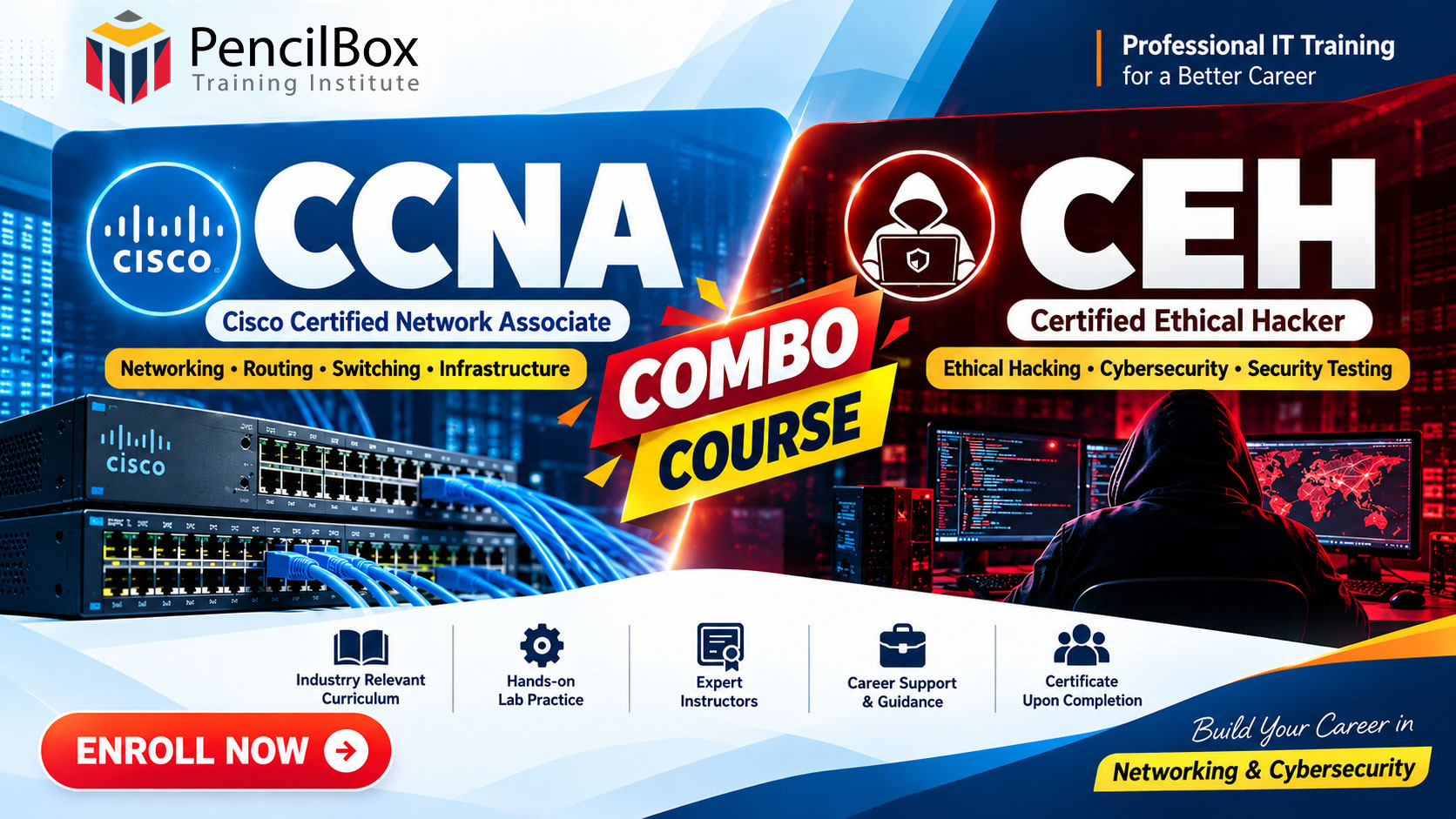
CCNA & Certified Ethical Hacker Combo (Batch No: 2)

CCNA & Certified Ethical Hacker Combo (Batch No: 2)

UPGRADE YOUR IT & CYBERSECURITY SKILLS
  • Start Date : 22-Nov-2026
  • Duration : 108 hours
  • No. of Classes/ Sessions : 36
  • Registration Deadline : 08-Feb-2027
  • Batch No : 2
  • Class Schedule :
  • Sunday (06:00pm-09:00pm)
  • Tuesday (06:00pm-09:00pm)
  • Thursday (06:00pm-09:00pm)
CCNA & Certified Ethical Hacker Combo apply

Introduction

Master Networking & Cybersecurity with comprehensive training in Networking Fundamentals, IP Addressing & Subnetting, Cisco IOS, Switching, VLAN, STP, Routing, OSPF, Wireless Networking, Network Services, Network Security, ACL and Troubleshooting. Learn Ethical Hacking, AI-Powered Cybersecurity, Reconnaissance, Network & Vulnerability Scanning, System Hacking, Malware, Sniffing, Social Engineering, Web & Application Security, SQL Injection, Wireless Security, Mobile, IoT, Cloud Security, Cryptography and AI-Driven Ethical Hacking through practical training.

Prerequisites : A basic understanding of Windows/Linux, English technical terminology, and an interest in Networking, Cybersecurity, and Ethical Hacking will be helpful. The course is suitable for IT/CSE students and graduates, IT professionals, networking enthusiasts, and beginners who want to build their skills and career in Networking and Cybersecurity.
Training Modules :

Module 01 — Networking Fundamentals

  • Introduction to Computer Networking
  • Network Types: LAN, WAN, MAN, WLAN
  • Network Topologies
  • OSI & TCP/IP Models
  • Network Devices & Functions
  • Ethernet & Network Media
  • MAC Address & IP Address
  • IPv4 & IPv6 Fundamentals
  • Unicast, Multicast & Broadcast
  • Encapsulation & Decapsulation
  • TCP vs UDP
  • Common Network Protocols & Ports

Module 02 — IP Addressing & Subnetting

  • IPv4 Addressing
  • Public vs Private IP
  • Network, Host & Broadcast Addresses
  • Subnet Mask & CIDR
  • Subnetting Fundamentals
  • VLSM
  • Subnetting Practice
  • IPv6 Address Types
  • IPv6 Address Configuration
  • Default Gateway

Module 03 — Cisco IOS & Device Management

  • Cisco IOS Introduction
  • CLI Navigation
  • User EXEC & Privileged EXEC Modes
  • Global & Interface Configuration
  • Basic Router Configuration
  • Basic Switch Configuration
  • Hostname & Password Configuration
  • Console & VTY Lines
  • Banner Configuration
  • Configuration Verification
  • show, copy, reload & troubleshooting commands

Module 04 — Ethernet Switching

  • Switching Fundamentals
  • Layer 2 Switching
  • MAC Address Table
  • MAC Learning & Forwarding
  • Collision & Broadcast Domains
  • Frame Forwarding
  • Cisco Switch Configuration
  • Port Security
  • MAC Address Security
  • Troubleshooting Switching Issues

Module 05 — VLAN & Trunking

  • VLAN Fundamentals
  • Access Ports
  • VLAN Configuration
  • Voice VLAN
  • 802.1Q Trunking
  • Native VLAN
  • VLAN Troubleshooting
  • Inter-VLAN Communication
  • Router-on-a-Stick

Module 06 — Spanning Tree Protocol

  • Switching Loops
  • STP Fundamentals
  • Root Bridge
  • BPDU
  • Port Roles & States
  • STP Configuration
  • Rapid PVST+
  • PortFast
  • BPDU Guard
  • STP Troubleshooting

Module 07 — EtherChannel

  • EtherChannel Fundamentals
  • Link Aggregation
  • PAgP
  • LACP
  • Static EtherChannel
  • Configuration & Verification
  • EtherChannel Troubleshooting

Module 08 — Routing Fundamentals

  • Routing Concepts
  • Routing Table
  • Connected & Local Routes
  • Static Routing
  • Default Routing
  • IPv4 Static Routes
  • IPv6 Static Routes
  • Floating Static Routes
  • Administrative Distance
  • Routing Table Analysis

Module 09 — Dynamic Routing

  • Dynamic Routing Concepts
  • Routing Protocol Fundamentals
  • OSPF Introduction
  • Single-Area OSPF
  • OSPF Neighbor Adjacency
  • Router ID
  • OSPF Network Types
  • OSPF Configuration & Verification
  • OSPF Troubleshooting

Module 10 — Wireless Networking

  • Wireless LAN Fundamentals
  • WLAN Architecture
  • Access Points
  • Wireless Controllers
  • SSID
  • RF & Channels
  • 2.4 GHz / 5 GHz
  • Wireless Security
  • WPA2 & WPA3
  • Wireless Troubleshooting

Module 11 — Network Services

  • DHCP
  • DHCP Client & Server
  • DHCP Relay
  • DNS Fundamentals
  • NAT & PAT
  • NTP
  • SNMP
  • Syslog
  • TFTP & FTP
  • QoS Fundamentals

Module 12 — Network Security Fundamentals

  • Network Security Concepts
  • Security Threats
  • Common Network Attacks
  • AAA
  • Authentication & Authorization
  • SSH Configuration
  • Password Security
  • Access Control Lists (ACL)
  • Standard ACL
  • Extended ACL
  • Layer 2 Security
  • DHCP Snooping
  • Dynamic ARP Inspection

Module 13 — Automation & Programmability

  • Network Automation Fundamentals
  • Traditional vs Controller-Based Networking
  • SDN Concepts
  • APIs
  • REST APIs
  • JSON
  • Controllers
  • Cisco DNA Center Concepts
  • Introduction to Network Automation

Module 14 — Network Troubleshooting

  • Troubleshooting Methodology
  • Physical Layer Troubleshooting
  • IP Connectivity Issues
  • VLAN & Trunk Troubleshooting
  • Routing Problems
  • DHCP/DNS Troubleshooting
  • ACL Troubleshooting
  • Wireless Troubleshooting
  • Cisco Troubleshooting Commands
  • ping, traceroute, show, debug

Module 01 — Introduction to Ethical Hacking

  • Cybersecurity & Ethical Hacking Fundamentals
  • CIA Triad
  • Threats, Vulnerabilities & Risks
  • Ethical Hacking Methodology
  • Types of Hackers & Cyber Attacks
  • Cybersecurity Laws & Ethics
  • Introduction to AI in Cybersecurity


Module 02 — AI-Powered Cybersecurity & Ethical Hacking

  • Generative AI for Cybersecurity
  • AI-Assisted Reconnaissance
  • AI for Threat Intelligence
  • AI-Assisted Vulnerability Analysis
  • Prompt Engineering for Security Professionals
  • Using AI for Security Automation
  • Risks, Limitations & Ethics of AI in Hacking
  • AI-Powered Attack vs. AI-Powered Defense


Module 03 — Footprinting & Reconnaissance

  • Passive & Active Reconnaissance
  • OSINT Fundamentals
  • DNS Enumeration
  • WHOIS & IP Intelligence
  • Google Dorking
  • Subdomain Enumeration
  • Email & Username Discovery
  • Tools: Nmap, theHarvester, Amass, Subfinder, WHOIS, Dig, Nslookup


Module 04 — Scanning Networks

  • Network Scanning Concepts
  • Host Discovery
  • Port & Service Scanning
  • OS & Service Detection
  • Vulnerability Scanning
  • Nmap Advanced Techniques
  • Banner Grabbing
  • Evasion Techniques
  • Practical Nmap Labs


Module 05 — Vulnerability Analysis

  • Vulnerability Assessment
  • CVE, CVSS & CWE
  • Vulnerability Identification
  • Automated Vulnerability Scanning
  • False Positives & Validation
  • Nessus/ OpenVAS/ Nuclei
  • AI-Assisted Vulnerability Analysis

Module 06 — System Hacking

  • Password Attacks
  • Authentication Attacks
  • Password Cracking Concepts
  • Hashes & Password Storage
  • Privilege Escalation
  • Persistence Concepts
  • Covering Tracks
  • Windows & Linux Security Testing
  • Tools: John the Ripper, Hashcat, Metasploit


Module 07 — Malware Threats

  • Malware Fundamentals
  • Viruses, Worms, Trojans & Ransomware
  • Spyware & Rootkits
  • Fileless Malware
  • Malware Analysis Fundamentals
  • Indicators of Compromise (IoCs)
  • AI-Assisted Malware Analysis


Module 08 — Sniffing

  • Network Sniffing Concepts
  • Packet Capture & Analysis
  • Protocol Analysis
  • ARP Spoofing
  • MITM Concepts
  • Wireshark & Tcpdump
  • Detecting Network Attacks


Module 09 — Social Engineering

  • Social Engineering Fundamentals
  • Phishing & Spear Phishing
  • Vishing & Smishing
  • Pretexting
  • Baiting & Tailgating
  • Social Engineering Prevention
  • AI-Generated Phishing & Deepfake Risks


Module 10 — Denial-of-Service

  • DoS & DDoS Concepts
  • Application-Layer Attacks
  • Network-Level Attacks
  • Botnets
  • DDoS Detection & Mitigation
  • DoS/DDoS Testing in Authorized Labs


Module 11 — Session & Web Application Security

  • Session Management
  • Session Hijacking
  • HTTP/HTTPS Fundamentals
  • OWASP Top 10
  • SQL Injection
  • XSS
  • CSRF
  • File Inclusion
  • Authentication & Authorization Testing
  • Burp Suite Practical Labs


Module 12 — Hacking Web Servers

  • Web Server Architecture
  • Server Enumeration
  • Web Server Misconfiguration
  • Directory Enumeration
  • HTTP Methods
  • Common Web Server Vulnerabilities
  • Security Hardening
  • Tools: Nikto, Nmap, Gobuster/ FFUF


Module 13 — Hacking Web Applications

  • Web Application Reconnaissance
  • Input Validation
  • Injection Attacks
  • Authentication Testing
  • Access Control Testing
  • API Security Fundamentals
  • OWASP Testing Methodology
  • Burp Suite Hands-on Labs


Module 14 — SQL Injection

  • SQL Injection Fundamentals
  • Error-Based SQLi
  • Union-Based SQLi
  • Blind SQL Injection
  • Authentication Bypass
  • SQLMap
  • SQL Injection Prevention
  • Practical SQLi Lab


Module 15 — Wireless Network Security

  • Wireless Network Architecture
  • Wi-Fi Security Standards
  • WPA/WPA2/WPA3
  • Wireless Reconnaissance
  • Packet Capture
  • Authentication Attacks
  • Wireless Security Testing
  • Aircrack-ng Suite


Module 16 — Mobile Platform Security

  • Android Security Fundamentals
  • Mobile Application Threats
  • APK Analysis Fundamentals
  • Mobile Permissions
  • Insecure Storage & Communication
  • Mobile Security Testing Concepts


Module 17 — IoT & OT Security

  • IoT Architecture & Threats
  • IoT Attack Surface
  • Firmware Security
  • IoT Network Security
  • OT/ICS Security Fundamentals
  • IoT Vulnerability Assessment


Module 18 — Cloud Computing Security

  • Cloud Security Fundamentals
  • AWS / Azure Security Concepts
  • IAM & Access Control
  • Cloud Misconfiguration
  • Storage Security
  • Cloud Attack Surface
  • Cloud Security Testing


Module 19 — Cryptography

  • Cryptography Fundamentals
  • Symmetric & Asymmetric Encryption
  • Hashing
  • Digital Signatures
  • PKI & Certificates
  • SSL/TLS
  • Common Cryptographic Weaknesses
  • Password Hashing & Data Integrity


Module 20 — AI-Driven Ethical Hacking Capstone

  • AI-Assisted Reconnaissance
  • AI-Assisted Vulnerability Analysis
  • AI-Assisted Log & Threat Analysis
  • Security Automation with Python & AI
  • AI Prompting for Security Tasks
  • Building an AI-Assisted Security Workflow
  • Responsible & Ethical Use of AI


Course Fee : TK. 25000 TK. 22000

Contact info

+88 01313 363836

+88 02 41010090

info@pencilbox.edu.bd